Monday, 14 January 2013
How small business agility, innovation and a network of professionals can lead to success in niche markets
Small businesses can often out-manoeuvre larger firms when addressing new market opportunities. Their ability to act and implement quickly are key areas of advantage. Going one step further and building a network of supporting professionals, means you can often create an entry barrier that makes it difficult for larger firms to compete.
An inspiring story recently served as a refreshing reminder of how the odds can be stacked in favour of agile small businesses. The key word here is agile.
Model Sounds UK was conceived and born in just three weeks and has gone from zero to a projected first year turnover of over £100,000.
Mark Thatcher, the MD of Model Sounds UK, became frustrated when he couldn’t find a solution to a problem concerning his model boat hobby. So he patched something together himself that seemed to do a good job. Thoughts soon extended to the sales potential as it was clear from Mark’s initial research that he’d found a gap in the market.
Mark quickly moved to set-up a functioning web site with his wife, and the Model Sounds UK business commenced trading just three weeks after the concept was developed in July 2012.
Mark started the business with less than £1000 and sold 53 units on his first trading day. Six months later, unit sales had exceeded 800 units and channel distribution was showing promising expansion.
This is a great illustration of small business entrepreneurship. Larger organisations normally require new ideas to be formally approved in advance by at least one senior manager. Such firms are locked into a planned programme of activities. Procedures must be followed to ensure all necessary compliance and governance rules are met, otherwise their insurance cover could be compromised. The need to “manage” gets in the way. This is why larger firms tend to be less agile. Smaller businesses are able to be more innovative and can act faster.
Innovation in small firms means having the right mind-set. Successful entrepreneurs often consciously look for new ways to improve an existing product or service, or look for gaps in the market. This conscious approach is a skill that small business owners can develop.
If you make a point of looking for market gaps or new ways to improve the items and processes you use every day, you will soon have a steady stream of ideas worthy of evaluation. The majority will fall by the wayside. Others will look more promising.
As a small business owner, you will be better placed than a larger company to quickly refine an idea, build a prototype and take it to market. It may not be a new business opportunity like the Model Sounds UK example; it might be an enhanced product offering or an improved service. The outcome will help to differentiate your position in the market, and to do so before a larger competitor can act.
What you will want to do is make sure that you allocate tasks and processes in the most efficient manner. This will help to keep costs as low as possible and so create an entry barrier that larger firms will need to address when they finally start to react to your initial market advantage.
So, for example, if you need to generate market awareness and leads quickly and cheaply but don’t feel your skills are in the area of blog writing or social media engagement, outsource the task to a professional at the outset. It’s pointless developing a new idea, only for it to lose early mover advantage because you decided on a DIY promotion strategy; one that doesn’t communicate the key messages or lacks professionalism. The same goes for technology support, logistics, parts sourcing and all other aspects of the value chain.
By building a network of small business professionals for each of the areas that are outside your core competence, you’ll be giving your innovation a better chance of success. Small business owners empathise with each other and will often work that bit harder to be part of a small business success story.
:::::::::::::::::::::::::::::::::
Outsourced marketing tailored to small businesses

Friday, 11 January 2013
How small businesses are winning new customers by blogging
Blogging and social media generate new leads at a lower cost per lead than traditional marketing tactics. They convert into sales too. This post looks at how small firms can produce the right level of blogs without taking business owners away from their day job.
Digital marketing tactics are fast becoming mainstream. They have gone beyond the experimental stage and are challenging traditional techniques like exhibitions, trade shows and direct mail in terms of lead generation performance.
Not only do digital techniques have a cost per lead that’s typically 60% lower than traditional tactics, but the lead quality seems to be just as good too.
Recent research published by Hubspot looked at the effectiveness of inbound versus outbound marketing techniques. Inbound refers to activities like blogs, content publishing, social media and web traffic resulting from SEO. Hubspot defines outbound as telemarketing, direct mail, trade shows and more traditional activities.
The findings highlighted a shift away from traditional marketing techniques towards inbound digital tactics. This has big implications if you are the owner of a small business keeping a close eye on your bottom line.
The research found that inbound digital techniques like blogging and social media had the lowest cost per lead. The average lead cost for traditional tactics was $346 which compares to a figure for blogging and social media of just $135 – a whopping 60% difference!
Looking at blogging and social media platforms, respondents claimed success in acquiring new customers from the following:
65% LinkedIn
55% Blogging
43% Facebook
40% Twitter
Hubspot went on to look at the lead-to-close rates to identify the most effective channels for lead conversion. This revealed the following metrics:
15% SEO
15% Direct traffic
9% Digital links / Referrals
7% Paid for Search
4% Social Media
2% Outbound calls
So, leads arising from SEO and via the web generally, had a higher conversion rate than outbound calls (15% versus 2%). It’s not entirely clear what actually falls under the terms “Direct traffic” or “Referrals”, but links from blogs and other published articles probably fall into the latter. Equally, one suspects that the results from nurture activity targeted at direct mail respondents or trade show visitors may fall under “Direct Traffic”.
In terms of blogging itself, the research identified a high correlation between frequency of blog posts and the ability of the technique to generate new business.

At first sight, this diagram could be a very scary one for small business owners: the more you post, the higher the probability of generating a new customer. However, evidence suggests that a third of SME bosses want to reduce the time they spend creating blogs or participating in social media. A couple of observations should help calm the nerves!
Firstly, you don’t need to post multiple times a day to benefit from blogging. You stand a greater than 50% chance of winning new business if you just post once a month. Publish more frequently and your chances of success will be even higher.
Given that it takes around three hours to compose a blog it’s no wonder that the time and effort involved appears onerous. Posting once or twice a week will get you near to a 70% success rate, provided the posts are of quality content and relevant to your audience.
That’s the real challenge; devoting the time to create quality content that is relevant to your audience. The higher the quality, the longer it will take to create. That can be a big problem when you’re also trying to run the rest of your business.
What’s to be done? You can’t stop producing blogs as they are a highly cost effective method of generating new business. Equally, you probably can’t afford to devote over three hours to produce every blog post.
Ideally you’ll have someone in your organisation able to take on the role of blog preparation. Alternatively, you’ll need to outsource the task to a professional or accept that it’s something you’ll have to continue to do yourself.
Building your social media and blogging presence in today’s economic climate has become an essential part of your marketing activity. The cost implications alone demand that you re-balance your marketing budget away from the more expensive traditional techniques in favour of more cost effective digital tactics.
Hubspot research respondent profile:
972 respondents in January 2012 (presumably US).
57% had less than 25 employees; 72% were B2B and 38% were owners or heads of business.
Industries included professional services, communications, technology, media, education and others.
::::::::::::::::::::::::::::::::::::::::::::
Copywriting and ghost blogging for small businesses
Thursday, 10 January 2013
How UK firms can benefit from the current wave of business optimism
New research in 2013 points to cautious optimism for UK small and medium sized firms. Business owners and managers can take steps now that will help them benefit from rising confidence and minimise the impact of any relapse.
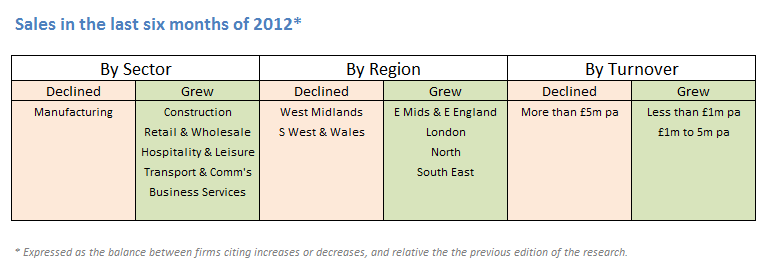
The latest edition of the Lloyds TSB Commercial research of UK SMEs offers some encouragement for small business owners. The 41st edition of Business in Britain highlights the areas that suffered during the last six months of 2012 but also points to across the board cautious optimism for the first half of 2013.
Mixed fortunes during the latter half of 2012
It seems that manufacturers in the West Midlands, South West and Wales with turnovers greater than £5m per annum suffered the most in the final half of 2012. Smaller companies elsewhere in the country were experiencing something of a recovery, albeit a mild one as the diagram below shows:
Cautious optimism for the first half of 2013
The research suggests that all sectors, business sizes and regions expect, on balance, to see more favourable trading conditions in the first six months of 2013. Firms have slightly more positive expectations for orders, sales, profits, staff hiring and capital spending.
In terms of challenges, the biggest concern is weak domestic demand. Additionally, firms have stated that regulation is becoming an increasing burden. Any knock to consumer sentiment could shatter the cautious levels of optimism seen in this research.
On the export front, it seems firms are satisfied with the EU’s promise to do whatever it takes to keep the Eurozone stable. However, any change to the EU’s ability to honour this commitment could see a return to volatility which, given that the region faces fresh bail-out concerns and looming elections in 2013, is a bit of a worry.
In the meantime, SMEs will be looking for the UK government to push forward with infrastructure projects and see progress from schemes like Funding for Lending.
How to make the most of this optimism
As a small business owner or business manager, you will want to make the most of these early signs of optimism. You could start by targeting those industries expected to benefit from government initiatives or companies that seem unaffected by current economic conditions such as these growth businesses.
You will also want to ensure your sales and marketing activities are cost effective too. Relying on traditional advertising and trade shows for lead generation can be an expensive and unproductive option. Blogging, social media and content marketing all appear to be more cost effective lead generation techniques without any compromise in lead quality.
Now is the time to review your marketing plans. Ensure your activities will make the most of the growing sense of business optimism. Check that your staff are addressing these new marketing techniques effectively and can track performance. Alternatively, if your human resources are already stretched, consider using outsourced professionals.
:::::::::::::::::::::::::::::::::::
Freelance copywriting and outsourced marketing for SMEs
Wednesday, 9 January 2013
How blogging and social media can improve your bottom line
Firms can reduce their cost per lead by up to 60% by adopting blogging and social media over more traditional marketing techniques. The problem for small businesses is how to create quality content without compromising business performance.
Recent research published by Hubspot highlights the extent of the shift away from traditional marketing techniques towards digital tactics. This has big implications if you are the owner of a small business, as digital communications can have a significant impact on your bottom line.
Whilst the research is US based, the findings are still relevant for the UK and Europe. The research looked at the effectiveness of inbound versus outbound marketing techniques. Inbound refers to activities like blogs, content publishing, social media and web traffic resulting from SEO. Hubspot defines outbound as telemarketing, direct mail, tradeshows and more traditional activities.
In truth, the Hubspot definition for outbound tactics can be challenged. It’s probably better to consider techniques in relation to their interruptive impact on the target audience. Inbound represents tactics where the audience are in control of when they engage with your business.
At the other end of the scale would be outbound phone calls / telemarketing which represent perhaps the most disruptive tactic when engaging your audience. In between are a range of other techniques reflecting different degrees of audience disruption.

The Hubspot research found that inbound tactics featuring low on the audience disruption scale also had the lowest cost per lead. This is reflected in the chart below which shows that blogs, social media and web leads from SEO enabled traffic, head the list.

The research also found that, on average, the outbound lead cost was $346 compared to just $135 for an inbound lead. That’s a massive 60% saving on average lead costs.
The inbound digital marketing techniques that were most successful in generating new business for B2B firms were:
* LinkedIn 65%
* Blogs 55%
* Facebook 43%
* Twitter 40%
The research does not say if any of these tactics were combined when generating new business leads but the overall trend is still impressive.
However, a separate report highlights that many SME owners find the effort required for social media and blogging too onerous. Some 33% of SME owners want to spend less time on this area. Yet, if they stop, they know it will directly impact their lead generation performance.
If you run a business and recognise the value blogging can contribute, you have essentially three options:
1. Write the blog posts yourself
2. Allocate the task to someone in your organisation
3. Outsource the task to a professional
Which option you choose will largely depend on your budget, the capability and bandwidth of your staff and the extent to which you enjoy writing.
Building your social media and blogging presence in today’s economic climate is fast becoming mandatory in order to maintain business awareness. The cost implications alone demand that you re-balance your marketing budget towards more cost effective digital tactics. They have moved on from being experimental fads to mainstream marketing tactics.
Traditional lead generation tactics will no doubt continue to play a key role in your lead generation programme. However, you should seriously consider how much of your budget should be allocated between traditional and digital channels for 2013.
Hubspot Research respondent profile:
972 respondents in January 2012 (presumably in the USA).
57% had less than 25 employees; 72% were B2B and 38% were owners or heads of business.
Industries included professional services, communications, technology, media, education and others.
:::::::::::::::::::::::::::::::::::::::
Freelance copy writing and marketing support for small businesses
Tuesday, 8 January 2013
How small business owners can implement social media and free-up more time for themselves.
Many SME owners adopt a DIY approach to social media which takes them away from actually managing their business. It’s a method that can back-fire badly. This post highlights the pitfalls and an alternative way forward.
Evidence from a recent survey points to a growing dilemma for small business owners. Many are embracing social media to promote their business but the opportunity cost of doing so is turning out to be higher than expected.
Conducted in September and October 2012, the survey by Vertical Response canvassed feedback from 462 firms, 93% of which had less than 100 employees and 43% of respondents were business owners. Whilst the research is US based, the findings can probably be applied to the UK and Europe too.
Managing Social updates
The survey found that 43% of respondents spent six or more hours per week on managing social media activity. Most of this was on updating Facebook and Twitter accounts. LinkedIn was mentioned by just half of respondents indicating a possible B2C bias in the data.
Blogs can work well, but…
Over half the sample managed a blog with 43% aiming to publish at least once a week. The problem is that 45% spend up to three hours to create a post with another 16% spending more than three hours on the task. The biggest problem cited was in finding suitable material to base the blog on.

The dilemma for small business owners
A third of the sample want to spend less time managing social media and blogging. However, research elsewhere indicates that almost 70% of firms find social tactics successful in generating new business. Stopping social marketing activity is therefore not something business owners really want to do.
That’s the dilemma. Social marketing is a relatively low cost activity that’s getting results but SME owners have a desire to spend time responding to needs elsewhere in the business rather than on content creation.
This is an area that warrants serious thought and consideration. Getting your social media communication strategy wrong can be very damaging to your business. Let me explain why.
The opportunity cost of your time
As the owner of a small business you’ll be stretched to cover all the bases. The benefit is that you’ll be most qualified to act as thought leader, as well as the person most able to take an item of industry news and overlay some added value for your audience.
However, if you don’t enjoy writing or don’t feel you have the right style or approach, you will end up spending much longer on the task than someone more able, and you may feel the output of your efforts are sub-standard anyway. That is time effectively wasted that could have been invested more productively elsewhere in your business.
Social media shapes how your brand is perceived
The material you publish is going to directly impact how your business brand is perceived by existing customers and prospects alike. Social media for business is different to that for personal use. The pressure to produce quality output is greater for business social media.
Your audience will view typos and mistakes as badly as those found in a glossy sales brochure. In effect, that is what social media is fast becoming – a key component of your online corporate brochure. Only instead of a hard copy brochure, your audience now expect to view your web site, downloadable material, blog and social media posts in order to obtain the insight into your business that was once only possible by reading a brochure.
Few business owners would trust themselves to produce their flagship sales and marketing material in-house. Rather, they would utilise skilled designers and printers to ensure that the most professional image is presented to the audience. Social media content is no different.
Unless you have a gift for and enjoy writing and creating charts, graphs, etc, you may be better off handing the task over to someone in your business who can focus fully on the job, or outsource the task to a professional. You’ll then be able to stay in control of the messaging by reviewing and influencing content before it’s published and still be able to dedicate more of your time supporting the parts of your business that need you most.
::::::::::::::::::::::::::::::::::::::::::::::::
Freelance copy writing and marketing support for SMEs
Monday, 7 January 2013
The online tools used by successful professional services firms
A study links higher adoption of digital marketing tools to greater business success amongst professional services firms. However, it varies by sector with some industries slow to adapt. That’s an opportunity for those firms that can move quickly. They could experience rapid growth if they embrace online tools.
The survey sample consisted of 500 US professional services (PS) firms operating in architecture, engineering, construction, marketing communications, accountancy, finance and technology in late 2011.
Hinge, who commissioned the research, looked at the number of PS businesses that generated leads online and matched this to the relative success of those firms in terms of growth and profitability.
They found that the more successful firms tended to generate more leads from online sources than their less successful peers. Taking figures from the report, this effect is highlighted in the chart below:

To help interpret this chart; of those that generate between 80 to 100% of their leads online, 60.7% are from the “successful” PS firms in the research. Only 15% of high growth / profit PS firms do not generate any of their leads from online sources.
The report goes on to highlight the inbound response methods from online activity:
* 43.9% - direct e-mail
* 28.6% - web form
* 24.1% - inbound telephone call
* 3.4% - other
This probably reflects the call-to-action mechanisms provided more than anything else but it does highlight that over a quarter are deploying web forms and generating sales leads as a result.
Hinge go on to look at the different online techniques that the sample used and how effective PS firms found them. It’s interesting to compare the rank order of techniques considered effective amongst PS firms to a similar study conducted in 2012 amongst small and medium sized businesses in general (i.e., not just PS firms):

The differences may allude to the different techniques required to be successful within different industries and professions. The SME audience are known to still be heavy users of traditional sales and marketing methods for lead generation. They are still experimenting with online tools. Having said that, over 50% of SME’s claim to be using all these methods.
If the professional services industry in the US can be aligned to that in the UK and Europe then these findings suggest that PS firms should embrace these techniques to improve lead generation and overall business performance.
Which professional service sectors perform best?
The Hinge report looked at which PS segments were using online techniques the most to generate leads:

This suggests that the majority of PS firms, especially those in architecture, engineering and construction, could achieve faster growth by focussing more effort on web lead generation.
Whilst traditional methods like personal networking, trade shows and exhibitions are still no doubt proven lead generation winners, the link suggested by the Hinge report about online adoption and business success really warrants close attention.
A common issue for PS firms new to online tools, is assigning management ownership internally and then finding someone suitably skilled to undertake the tasks. That person may not even exist in the headcount. What’s more, the management team may be unsure about the skills required to complete the task or the level of budget that should be allocated for this activity to be effective.
One solution to this would be to engage an external resource just to get things going. That external resource could set-up an initial online content marketing programme. Also, if agreed at the outset, the external partner could organise the programme to facilitate knowledge transfer and training to an in-house resource. Based on this research, the cost of the external resource should pay for itself from new incremental business.
Technology has changed the way firms do business. Digital technologies and social media communications have reached a tipping point and firms across all industries are now grappling with the impact of the changes on their business. Delaying the inevitable adoption of online marketing may prove to be a risky strategy.
::::::::::::::::::::::::::::::::::::::::::::::::::::::::::::::::::::
Freelance copy writing and marketing support for small businesses
Saturday, 5 January 2013
These survey findings could impact your business planning for 2013
A CBI report highlights what businesses in London expect for early 2013. Small businesses elsewhere in the UK can use these findings as an aid to making their investment decisions for the New Year.
A report from the CBI provides some useful guidance that UK small businesses can use when planning for 2013. Based on a survey of 168 firms in London, the findings may help SMEs elsewhere in the UK too. The survey was conducted between September and October 2012 and 64% of respondents were SMEs. Some 56% were in professional services, hospitality, leisure, retail and the financial sector.
Perhaps the most positive finding was that 53% of SMEs felt more optimistic about the economic outlook for the first part of 2013 with only 13% more pessimistic (down from 22% in 2011).
Identifying the requirements needed to drive growth, SMEs in the survey mentioned:
1. More competitive tax system (36%)
2. Stimulate bank lending (31%)
3. Push ahead with infrastructure projects (19%)
4. Support for small business innovation (18%)
In a separate report, the UK Federation of Small Businesses has indicated cautious optimism amongst its members for 2013; they see slight growth but are concerned about rising cost pressures.
How these findings could influence your decision making for the early part of 2013
The diagram below attempts to understand the inter-relationships between the concerns raised in the CBI survey and the priorities highlighted as requirements for growth. The government may well be influenced by reports like those from the CBI (despite the small sample size) and the FSB, so these findings could indicate the direction of short-term stimulus.

From this chart, you could conclude that the threat of recession will remain a serious undercurrent well into 2013:
* The Eurozone crisis looks unlikely to change quickly for the positive
* Traditional bank lending likely to remain unchanged until structural reforms are introduced
* Schemes like Funding for Lending are unlikely to show any benefit until well into 2013
* Little sign yet of additional measures to stimulate growth
Any significant government stimulus looks to be focused around infrastructure projects so unless your business is closely involved with the construction sector, any immediate ripple effect from these projects will take time to work through.
SMEs will probably need to constrain investment to self-funded activities or investigate the emerging trend towards peer-to-peer lending. In all probability, SMEs will need to rely on targeting local or niche firms for new business, particularly those identified for growth.
At the same time, small firms will need to continue keeping a close eye on the effectiveness of their investment in people, equipment and marketing. With business confidence fragile and funding set to remain tight, SMEs will need to strive to improve both the effectiveness and efficiency of their existing new business generation activities.
Doing more for less is likely to remain a key mantra for a long time yet. Consider switching those marketing and lead generation activities that are no longer performing as well as they used to, towards newer and possibly less expensive tactics like digital and social media.
:::::::::::::::::::::::::::::::::
Freelance copy writing and marketing support for SMEs
Subscribe to:
Posts (Atom)