Showing posts with label small business. Show all posts

Saturday, 23 March 2013

The content marketing tactics proven to work for UK B2B firms


Business-to-business firms can save themselves a lot of time and money by taking note of some recent content marketing research. The survey asked UK firms about their experiences with different content marketing tactics.  

The research findings appear to have identified those tactics most effective in driving new business.  Small businesses can save themselves a lot of hassle by taking advantage of these findings.  Here’s a quick look at the results.

The content marketing tactics considered to be most effective

The diagram below shows the tactics found to be most effective amongst a sample of UK firms, in rank order.  Case studies and research reports top the list followed by a string of other tactics: 


The content marketing tactics that work for UK based businesses


Surprisingly, the research does not refer to corporate blogs as a technique and yet blogs are considered a valuable tactic in other studies.  It’s possible that UK firms have yet to embrace the potential of corporate blogs.

Also, online articles (on own web sites and external sites) appear to rank lower than other studies suggest.

If you are a B2B firm wondering how to drive online performance using content marketing, you might want to start with the top tactics from this research. Take a look at this post for ideas on generating new case studies.


About the respondent sample

You should review the findings above in the light of some limitations regarding the sample. 

Respondents came from subscribers to the Content Marketing Institute and the Direct Marketing Institute in the UK.  As such, they are likely to have a keener interest in trying different marketing tactics and have higher than average content marketing budgets. The sample consisted of 190 respondents as follows:

* 67% - B2B
* 18% - B2C
* 15% - Other (public sector / not-for-profit)

Breakdown by employee size:
* 50% had up to 99 employees
* 21% between 100 and 999 employees
* 29% more than 1000 employees

Industry profile:
* 46% marketing, media, publishing, online services
* 8% consulting and business services
* 5% banking, accountancy and financial services
* 5% software
* 36% other

Whilst the respondent profile may not match your business, the research is still useful as these respondents have probably put the greatest effort into understanding what content marketing techniques work best in the UK.  It acts as a good start point for firms trying to decide where to invest their content marketing budgets for maximum effect. Get your marketing team busy conducting surveys and writing-up customer case studies!


:::::::::::::::::::::::::::

Thursday, 28 February 2013

It's time to take business blogging seriously


Many small firms are turning to business blogging as part of their lead generation process.  Not only do blogs allow complete control over the editorial content, but business blogging can also produce sales leads up to 60% cheaper than traditional marketing activities.  

It's time to take business blogs seriously
Image credit: Bigstock


In the US and, in all likelihood, in Europe too, small firms are turning to the creation of blog content to help generate new business. Heidi Cohen outlines some of the key reasons why business blogging is now such an important marketing tool.  Businesses that are quick to understand the benefits will be better positioned to reap the rewards as industries in general embrace new digital marketing techniques.  Let’s look at the benefits.

A media platform you control

Unlike press releases which are exposed to the whims of editors, with blogs you have full control over the content that is published. Provided your blog is well written and not an overt sales pitch, you'll be able to create marketing messages and calls-to-action exactly as you want them.  And, as blogs have the option for readers to leave comments, you also have a great way to interact with and influence your customers too.  

It means you can actually demonstrate things like customer responsiveness, integrity and industry competence. In fact, your corporate blog can very much determine a major part of the customer experience and, being social in nature, word-of-mouth about a good experience can travel fast.

Integral to your search and social media strategy

The way most blogging platforms are created means you can write content that search engines will utilise for search queries. The more your blog site and content is set up for SEO, the higher your search rank and the greater the probability that your blog content will be found by the target group you are aiming at.

The social nature of blogs is a key ingredient that businesses need to understand too. The blog itself can highlight your industry expertise, customer ethos or corporate personality. Your task then is to extend your audience reach through other social media platforms.  Linkedin, Google-Plus, Facebook, Twitter, Pinterest and others, effectively become your advertising medium.  

By building-up a following, you'll be able to drive traffic back to your website. If you make that experience meaningful to your business audience, word will spread quickly to others. Compared to traditional print publications, business blogs are a much cheaper and more targeted way to reach your audience.

Content that drives lead generation

With complete editorial control over your content, you are able to exploit links to other related content too. So long as you have aligned your web content to the right buyer persona / stage, you can create content that systematically moves visitors along the sales lead funnel process.

That's not something you’ve been able to do so comprehensively in the past. As Heidi Cohen highlights, your blog archive is effectively a content management system.  Each item can have links that help your audience navigate towards sales engagement. What’s more, as most blog platforms have some form of analytics package, you can track, monitor and enhance performance to make the whole process very effective.

It's time to take blogging seriously

As the digital marketing landscape evolves, more and more small firms are recognising the potential of the corporate blog on business performance.  Not only can they generate leads up to 60 per cent cheaper than traditional tactics, but with careful planning, business blogs can become part of the lead generation process itself, helping you to nurture and qualify new sales opportunities.  Being dismissive of corporate blogs could be a very costly mistake!

Business blogging is fast becoming an integral and cost effective part of the marketing toolkit.  If you can’t find the time yourself to create blogs, consider making it part of an employee’s job description. Alternatively, hire a marketing copywriter to write them for you.  Once you have established an initial archive of material, you’ll be able to exploit the “linkability” of your content to generate high quality leads more consistently.

:::::::::::::::::::::::::::::::


Marketing copywriting for business professionals short of time

Friday, 15 February 2013

Evidence that a content marketing strategy can boost performance in any industry


A recent case study suggests that the impact of carefully targeted content on business performance can be significant.  Getting the content marketing strategy correctly defined is the first key step to take.  And it’s not just for larger enterprises: small businesses can benefit too. 


Some small business owners feel that content marketing can’t be applied to their business.  They claim their industry is mundane or even “boring”.  Some have a tarnished public images.  Unless you’re a large enterprise that can afford a well-funded PR programme, the feeling amongst many smaller firms is that content marketing can be a waste of time.

However, the experience of Simply Business suggests that content marketing can deliver impressive results even in an industry like insurance, where products are largely commoditized and reputation has suffered somewhat following the financial crisis.

Lucjan Zaborowski revealed how he applied some key content marketing rules to increase web traffic to the Simply Business site by 25%, achieve outstanding SER, and improve the conversion rate too.  Whilst Simply Business may be more of a medium sized enterprise, this approach can work for smaller firms as well.

It’s all about marketing content

The first of Lucjan’s steps was the generation of new ideas that reflected the company’s mission.  For most small businesses, the concept of a mission statement was only ever considered when the original start-up business plan was created.  The term has probably been pushed aside in the fight to get new orders flowing and generally survive.  

The term “content marketing” could well go the same way; it’s something of a buzzword.  However, if you think of it as "...marketing your content..." (articles, brochures, case studies, blogs, etc.) it starts to have greater meaning.  What’s really important is that small firms truly get to understand how they can:

  • Solve the problems experienced by their customers
  • Differentiate themselves against competitors

With a clear awareness of these aspects, you, as a small business owner, will be able to formulate how you want to position your business in the market and document a few key messages to use in PR and other public facing communications.  Consider engaging an external marketing professional if you struggle to make progress in this area.

Developing a realistic content marketing strategy

Lucjan’s next step was to identify useful content. Simply Business applied three criteria to ensure the content marketing strategy they created was right for their audience.  The criteria encompassed:

  • Applicability – is the content relevant to the needs of the audience
  • Usefulness – in addition to relevance, is the content something practical that the audience can use?
  • Consistency - ensuring content adheres to consistent messaging and tone of voice

This comes back to understanding your audience.  What are your customer pain points?  How do they go about looking for solutions to problems? It’s really important to understand what information they are looking for at each stage of the buying cycle.  It’s not as difficult as it sounds as this article highlights.  One of the first things to do is identify the different stages of the buying cycle as they apply to your industry.  A typical example could look like this:


In a nutshell, you need to categorise your audience by job description and build a profile of what information they are looking for at each stage of the buying process. Some call this building a "Persona".

The next step is to review your existing content against the information needs of each audience profile group or persona.  Be brutally honest about how well your existing materials support the information needs of each group.  Getting external input here is highly recommended, ideally some of your customers.  The challenge is to identify gaps in the information you are making available. What content hits the sweet-spot? What needs to be tweaked? What new material needs to be created from scratch?

Find a good content writer and track your performance

Simply Business achieved some impressive results after applying this approach to content marketing.  Web traffic increased by 25% and they reached front page SER.  Conversions increased by 6% too.  That’s the final point Lucjan mentions; tracking performance.

Not only do you need to see what's working and what's not, but you also need to know when trends are changing.  The thing to remember is that search terms and buyer behaviour are never static.  

Some content will “tire” and require refreshing.  That's why it’s always worth testing different versions of content regularly.  You need to be sure your “control” is the best at driving traffic to your site and the most effective at converting enquiries into orders.  The "control" will under perform at some stage and you need to know when.

Consider using an external content writer / copywriter to help you with your content creation and testing programme.  A different pair of eyes can lead to a step change in performance by trying a new approach to the same subject.  It’s a way of breaking out of the “groupthink” that's inherent in any team or organisation established for any length of time.

Finally, the thing to remember is that Lucjan applied this process to an insurance company. This is an industry considered to have a fixed set of mundane products as well as a somewhat tarnished public reputation.  His case study implies that a well-structured content marketing strategy can be successfully applied to any industry, no matter how mundane it may first appear.

:::::::::::::::::::::::::


Freelance marketing copywriting for small and medium sized businesses

Tuesday, 12 February 2013

How small business owners can enhance performance with the right content marketing strategy


Many solo entrepreneurs resort to doing everything themselves. Bookkeeping, selling, cleaning, buying, customer service and promotional activity. As their business grows, the demand on their time increases.  It’s at this point when small business owners should identify tasks that are better outsourced to a professional.  Content marketing is an obvious candidate.


For many small B2C firms, a Do-It-Yourself content marketing strategy is the obvious way to generate the material to attract web traffic.  But is a DIY strategy a false economy?

If you have to rely on a vehicle to keep your business running, do you take time out to service it yourself or do you use a professional?  If you’re really competent at vehicle mechanics, and enjoy it, then it may be an option you consider.  But if motor maintenance is not your thing, you will probably find a reliable mechanic instead.  You can then use the time you might have spent on servicing to look after another part of your business.  

It’s the same for content marketing.  There are times when it’s best to use a professional.  Let me explain.

A recent study highlighted the benefits B2C firms experienced after deploying different types of content to promote their business.  Take a look at the following:

Content Marketing in B2C firms


The graphic above suggests that around three quarters of B2C firms have had a good experience with content marketing.  They have seen improved brand awareness, a higher search engine ranking and increased web visitor numbers.  Almost 50% are using content marketing and social media to reduce traditional advertising costs and generate new leads.

The content that seems to be getting the best results are articles, blogs, social media posts and videos.  E-newsletters and whitepapers also continue to track well.  As B2C firms plan to invest further in these techniques during the coming year, they can be assumed to reflect past success.  

The research goes on to find that some 61% of B2C firms in the survey write their own content. That’s understandable, as many small firms are on a tight budget. But a DIY strategy could be a more expensive option in the longer term.

The same research found that 79% of small firms spend up to ten hours a week on content creation.   That’s a big chunk of time if you’re a solo entrepreneur.  Consider the following:

Evidence suggests that it takes, on average, three hours to write a blog post. A carefully researched article or whitepaper takes even longer.  That means you might be able to generate two or three blog posts per week or perhaps one carefully constructed article.  But, is that enough for your on-going lead generation needs?  Research elsewhere links the frequency of blog posts to the volumes of leads generated.  So, the more you post, the greater the probability of generating leads.

All this means that the task of content creation will make increasingly more demands on your time as you strive to increase lead volumes and conversions.  It will sap your effectiveness and pull you away from other business tasks demanding your attention.

What’s to be done?

If you don’t enjoy researching, writing and generally pulling together quality content that will engage your customers, try testing the outsourced option.  Try it for three months.  Monitor the impact it has on your business performance, and stress levels!

You will be able to keep control of the style, tone and editorial content and track if search rankings and traffic levels improve.  If you brief your copywriter well, you should see an improvement in lead quality and conversion rates too. Plus, you should assess the value of your re-allocated time; time you would otherwise have spent writing content but which can now be used more productively elsewhere in your business.

If after a three month test, you don’t see a worthwhile improvement in business performance, you can try another content professional or go back to the DIY approach.  If you get it right, you will have grown your business and be better placed to drive the rest of your business forward to the next level. 

:::::::::::::::::::::::::::

Fixed price copywriting and ghost blog writing offers for small business

Sunday, 3 February 2013

The content that will make a long term improvement to your online conversion rates


For many B2B and B2C firms, improving web traffic and online conversion rates is a key focus of attention. However, studies suggest that too much emphasis is placed on generating social media “likes” when more sustainable alternatives exist.  This post looks at some of the options.

Including some form of endorsement on your website can have a significant impact on web conversion rates.  If your customers are end-user consumers, then star rating widgets and mini reviews/feedback pages can be really important.  

Indeed, it has been said that 70% of consumers look at product reviews and site popularity before deciding to buy. So, if you’re a consumer oriented business, including social media icons on your site is a must, provided your site is popular.

If your audience is not prone to declaring its preferences, or you are a B2B businesses for example, evidence suggests it’s better not to show any social icons on your site at all. It’s argued that your conversion rate could actually suffer if you use social icons that have low participation scores (“likes”).

So, what else can you do if you’re a small business looking to increase web traffic and conversions?  One answer is to generate content such as product reviews, case studies and customer testimonials.  These are obviously time consuming to create but offer a more enduring benefit.  Here’s why they represent a better option than social icons for improving your conversion rates: 

1 The Story Factor:

Well written content is more akin to storytelling, and there is strong evidence to suggest that a good story can be highly persuasive in the sales process.


2 Crowd Support:

A carefully crafted review, case study or testimonial can make use of “crowd-power”.  By implying, positively rather than negatively, that peers are already acting on the information being presented, the reader feels more comfortable about acting (deciding to buy) themselves.

3 Flexibility:

Written content allows you to include supporting assets like images, videos and hero endorsements.  They can also be easily tailored to meet the information needs of different groups of people in the buying process.

All-in-all, B2B and B2C firms are better advised to focus on creating strong, powerful articles, reviews, case studies and customer testimonials rather than rely on chasing social “likes” to increase web traffic and conversions.

That’s not to say that social media doesn’t have a role to play.  Social platforms should be used to promote the availability of written content, along with SEO, PR, email and other traditional tactics.

The key success factor in all this concerns the quality of the copywriting involved.  Articles, case studies and testimonials need to be written in a way that really engages your target audience.  Each item of content must consistently highlight your competitive advantage, key messages, and provide a compelling call-to-action.

If you’re serious about improving your online performance, then these points are too important to ignore.  If you don’t have the time or skills in-house to write these articles and case studies, consider outsourcing the task to a professional.  You’ll see the benefit through improved web conversion rates!

:::::::::::::::::::::::::::::::::::::::

Freelance copywriting for small and medium sized businesses

Tuesday, 29 January 2013

Key tips to help you win more business from large enterprises


Understanding how decision makers in large companies decide on a short-list of candidate vendors can be a big advantage for a small or medium sized firm.  This article explains the content they find most valuable, how important they find social media, and even when they want to be contacted.  Your window of opportunity is just six days!

Large enterprises (LE) represent an attractive sales target for small and medium sized businesses.  A recent study by IDG looked at how IT decision makers in LE’s go about making purchasing decisions.  The findings offer small firms a real opportunity to be in the right place, at the right time, with the right proposition.

IDG asked 1025 decision makers what type of information they found most valuable when searching online to solve a problem or when looking for a new product or service.  Here’s what they found:

Articles, reviews and case studies came top of the list, with brochures and other content likely to be on your website not far behind.  So, content is king if you want to attract the interest of large enterprise buyers.

Interestingly, IDG also found that IT decision makers appear ready to be contacted by a prospective vendor after they have downloaded two or more items from a web site.  Not only that, but they would prefer to be contacted within six days of making an additional download.  

This represents a clear signal of interest that all firms will want to be aware of.  No doubt, as a small business owner, you will want to have this trigger embedded within your internal lead management process.  But how?

In truth, this is a real dilemma for many firms.  Unless you use some form of marketing automation system, you will need to “gate” or put a form in front of the download process.  The details on the form will identify who is downloading.  Consequently, using the form, you can track when a prospective buyer has downloaded more items from your website.  

However, expert opinion suggests that putting any form filling in front of a download will significantly reduce the number of people that actually go on to make the download.  Instead, they will find other web sites where access to articles and case studies are unencumbered.  You will effectively loose that prospect.

The answer is to do the following:

  • Make your downloadable content free to access.
  • Write your content in such a way that it compels serious prospects to complete a form linked within the content itself.

This will require a little creativity: perhaps a small promotion or access to a no-obligation ROI tool, etc.  The skill of the copywriter is the key ingredient.  Consider using a professional copywriter to create or edit your content if you don’t have these skills in-house.

How IT Decision Makers use Social Networks

The IDG study also identified the extent to which IT decision makers turned to social networks as part of their quest for information.  Not only do they use social platforms for networking and career enhancement, but many use them to discover, share and discuss technical information and seek answers to problems.

Linkedin was used by 72% of the IT decision makers surveyed, but the main purpose was for career progression.  When they wanted to find technical information, the top three platforms they turned to were:

  • Twitter (59%)
  • Google Plus (54%)
  • Facebook (50%)

At least that was the case in May 2012 when the study was undertaken.  Interestingly, IDG also identified what decision makers claimed to use social media (including Linkedin) for.  Here’s what they found:

  • 73% - to engage with a technical vendor
  • 44% - to stay up to date with industry trends
  • 38% - to find reviews and recommendations
  • 35% - to find information to aid decision making

Clearly, if you are targeting IT decision makers, it’s important that you are visible on social media and that you can interlink content between your web site and social platforms.  As social media becomes more generally accepted, it’s likely that prospective buyers across all industries will use these platforms to find potential suppliers.  Some will use social platforms as much as they will use a Google search.  Indeed, having a presence on social media platforms is likely to improve your search engine ranking.

Many firms are not yet ready to fully embrace social media.  However, if you want to sell to large organisations, you need to ensure that your sales and marketing content is organised and freely available for when prospects come looking.  Having professionally written articles, case studies, blogs and product literature will go a long way in positively influencing your prospects and help to get your business on the short list.

:::::::::::::::::::::::::::::::

Freelance business copywriting and blog ghost writing for SMEs

Thursday, 10 January 2013

How UK firms can benefit from the current wave of business optimism


New research in 2013 points to cautious optimism for UK small and medium sized firms.  Business owners and managers can take steps now that will help them benefit from rising confidence and minimise the impact of any relapse.


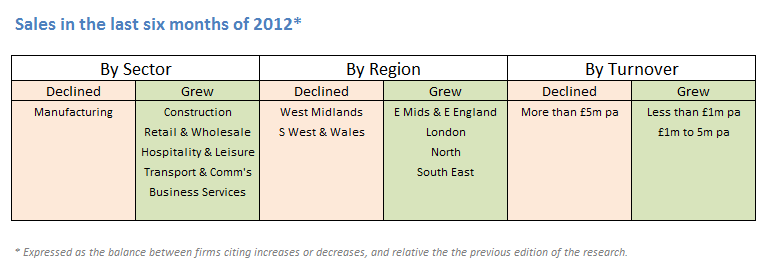
The latest edition of the Lloyds TSB Commercial research of UK SMEs offers some encouragement for small business owners.  The 41st edition of Business in Britain highlights the areas that suffered during the last six months of 2012 but also points to across the board cautious optimism for the first half of 2013.

Mixed fortunes during the latter half of 2012
It seems that manufacturers in the West Midlands, South West and Wales with turnovers greater than £5m per annum suffered the most in the final half of 2012.  Smaller companies elsewhere in the country were experiencing something of a recovery, albeit a mild one as the diagram below shows:


Cautious optimism for the first half of 2013
The research suggests that all sectors, business sizes and regions expect, on balance, to see more favourable trading conditions in the first six months of 2013.  Firms have slightly more positive expectations for orders, sales, profits, staff hiring and capital spending.  

In terms of challenges, the biggest concern is weak domestic demand. Additionally, firms have stated that regulation is becoming an increasing burden.  Any knock to consumer sentiment could shatter the cautious levels of optimism seen in this research.  

On the export front, it seems firms are satisfied with the EU’s promise to do whatever it takes to keep the Eurozone stable.  However, any change to the EU’s ability to honour this commitment could see a return to volatility which, given that the region faces fresh bail-out concerns and looming elections in 2013, is a bit of a worry.

In the meantime, SMEs will be looking for the UK government to push forward with infrastructure projects and see progress from schemes like Funding for Lending.

How to make the most of this optimism
As a small business owner or business manager, you will want to make the most of these early signs of optimism.  You could start by targeting those industries expected to benefit from government initiatives or companies that seem unaffected by current economic conditions such as these growth businesses.

You will also want to ensure your sales and marketing activities are cost effective too.  Relying on traditional advertising and trade shows for lead generation can be an expensive and unproductive option.  Blogging, social media and content marketing all appear to be more cost effective lead generation techniques without any compromise in lead quality.

Now is the time to review your marketing plans. Ensure your activities will make the most of the growing sense of business optimism.  Check that your staff are addressing these new marketing techniques effectively and can track performance.  Alternatively, if your human resources are already stretched, consider using outsourced professionals.

:::::::::::::::::::::::::::::::::::

Freelance copywriting and outsourced marketing for SMEs


Wednesday, 5 December 2012

What successful small businesses do differently to win new customers


A recent study has revealed the different behaviours used by successful SME’s over their less successful rivals, highlighting the new marketing tactics that are helping to win new business.

A recent report of small and medium sized businesses provides a useful insight into the different behaviours adopted by those succeeding in the current climate compared to those doing less well.

The study was conducted amongst 208 SME marketing decision makers in North America via an online survey in August and September 2012 (see below for respondent profile).  The research appears to define “successful” as a company exceeding its planned business targets for the year and those less successful as those behind budget.  

Clearly the different budget setting processes adopted by each business represents something of a question mark over these results, but the research was undertaken by much respected Forrester Consulting and so should be robust.  (If you want to view the full report, download it from Act-On Software who commissioned the research).

What do successful SME’s do differently?
One of the tables in the report highlighted the extent to which successful SME’s differed from less successful ones in terms of what they found most challenging.  Using the figures from the report, table 1 below shows the “Marketing Challenge” profile between the two groups.

Table 1:  Biggest Marketing Challenges


Whilst the profiles differ in terms of rank order, significant differences are few.  Table 2 looks at the percentage gap between the two groups.

Table 2: Differences in perceived marketing challenges:


Increasing sales from existing customers appears to be the widest gap between the two groups.  It seems that the more successful firms found this less of a challenge, presumably as they have strong relationships with existing customers already and / or are actively looking to acquire net new customers.

If the presumption is correct it would help to explain the second and third largest gaps between the two groups. Having secured strong relationships with existing customers, the more successful firms look to maximise the performance from existing lead generation activity.  They appear to have less of an issue generating new leads or in raising awareness (that’s not to say they don’t have a challenge in these areas, just less of one).

Less successful firms have a greater struggle differentiating themselves from competitors.  This implies a weakness in market positioning and possibly under-developed customer facing marketing and sales content.

The tactics SME’s use to acquire new customers:
Around 20% of respondents from both groups find it challenging to drive traffic to their website and generate new leads.  This is unsurprising when you look at the techniques they use to acquire new customers, which are heavily weighted towards traditional sales techniques.

The research report unfortunately does not give a break-down of tactics between the two groups of firms – choosing instead to compare SME’s to larger enterprises.  Despite this, table 3 does reveal some useful insights.

Table 3: Tactics SME’s use to acquire new customers:


Traditional methods remain prevalent (i.e., personal relationships and networking, trade shows, print advertising and PR).  What is interesting is that around three quarters of respondents claim to be using “Content Marketing”, SEO, email marketing, lead nurturing and social media to target new customer acquisition.  

This probably reflects the innovative instincts of the SME respondent audience sampled and that they are investigating these options rather than declaring them as tried and tested tactics to acquire new customers.  Having said this, the report goes on to explore one new customer acquisition method that does appear to be succeeding – social media.

SME’s are winning new customers through digital and social media channels:
The report highlighted the extent to which SME’s are using different digital and social tactics to acquire new customers.

Table 4: Digital and social media tactics used by SME’s for customer acquisition:


This table reflects the tactics SME marketing decision makers claim are working and intend to continue using.

So, over half of this population of 208 North American SME marketing decision makers are using video to help in their customer acquisition activity, closely followed by social networking sites and then blogging.  More to the point they feel these tactics are working.

This is consistent with another report conducted earlier in 2012 amongst marketing decision makers in North America, although this sample included marketing professionals in larger enterprises too.  This showed high usage of social media (87%), content marketing (83%), blogs (77%) and video (70%) too.

If this North American research translates into a similar experience in the UK and Europe, then we can conclude that:

  • Traditional customer acquisition methods remain the most popular, however…
  • Two thirds of SME’s are exploring digital and social media tactics and almost 50% feel they are yielding success
  • Over 80% of SME’s recognise the importance of content marketing yet...
  • ...some 20% still struggle to drive sufficient traffic to their web site or generate sufficient lead volumes.


The report is not clear about the underlying causes for these challenges – typically it’s around work load, limited time, budget and/or a lack of skilled resources.  The cost effectiveness of leads generated from traditional methods relative to digital or social sources was outside the scope of the Forrester research but should also play a key role in SME marketing planning.

Small and medium sized businesses are limited in terms of the number of exhibitions and events they can attend and the number of times they can tap existing customers for new business.  Growth is most likely to come from spending more on advertising or using the newer digital and social media channels.  

For this to be effective, firms will need carefully crafted content in sufficient volumes to maintain awareness amongst its target audience and keep prospects engaged.   If social media has reached a tipping point in terms of business acceptance, then owners of small and medium sized businesses need to expand their skill base even further or utilize external support.   As the Forrester report highlights, it’s the digital and social routes that are more scalable and represent the best techniques to adopt for growth.  

~~~~~~~~~~~~~~~~~~~~~~~~~


Source: “Driving SMB Revenue in a Tough Economy”, conducted by Forrester Consulting, commissioned by Act-On Software.

Data profiles: 208 SMB marketing decision makers based in North America.  An online survey conducted between August and September 2012.  Employee size breakdown:
48% - 50 to 249 emp
16% - 250 to 499 emp
14% - 500 to 999 emp
22% - 1000 to 2500 emp

:::::::::::::::::::::::::::::::::::::


Part-time content marketing and lead generation support services for SME’s
Freelance content creation support for busy marketing professionals


Friday, 30 November 2012

Content Marketing: What really attracts customers?


If you run a small business you'll know how hard it is to attract new customers and maintain relationships with existing ones.  New research highlights which tactics work better than others.  This post highlights the communication tactics you should you focus on.


Research undertaken in August 2012 provided some useful insights into the type of content businesses are producing to engage with customers.  “B2B Content Marketing: 2012 Benchmarks, Budgets, and Trends—North America” was produced by MarketingProfs and the Content Marketing Institute.  Whilst the sample (1416 respondents) consisted of business-to-business marketing professionals based in North America, the findings offer value to marketing professionals and owners of small and medium sized businesses in Europe too.

One of the most eye-catching charts highlighted the tactics which were being used the most.  The top ten were identified as:


The research says that all tactics have seen an increase in use over the previous twelve months (except for print magazines).  However, the most rapid growth came from tactics not in the top ten, notably, research reports, videos and mobile content.

Looking at the findings, one can’t help but assume that the same content is being distributed in multiple ways.  Many respondents appear to be publishing through as many channels as are available, possibly as no clear channel has yet emerged as more beneficial than another.

Furthermore, the highest quoted tactics tend to act more as a push media channel rather than a true content marketing tactic, which tends to confuse matters.  Re-allocating the stated tactics under different headings helps.  

Looking at the categories listed it’s possible to split them into something more meaningful:


One question to ask about this is whether these channels align to the level of effort required to use them (with posting on social media being the easiest)?  If this is the case then these findings are as one would expect.


Between a quarter and a third of respondents continue to use traditional media vehicles to attract customers.  The In-Person Events is particularly interesting.  Could this be due more to the fact that it also aligns with the preference of the sales force?  Budget allocation will be more likely if the Sales Director supports face-to-face events.


This chart focuses more closely on content types used in digital environments.  The first two mentions should perhaps  be discounted as they may just be vehicles to publish the other content assets underneath (from case studies to ebooks).


Implications

Just publishing / posting content on web or blog sites can be a waste of time and effort unless the content has been carefully created, includes appropriate keywords and is aligned to a specific audience.  It takes considerable effort. The same research claimed that the biggest challenge for respondents was producing enough content.  That’s a statement from marketing professionals so it will be even more of a challenge for owners of small and medium sized businesses.

So, where should you be focussing your marketing attention?

The most effective options are probably:

* Case studies of successful customer / order implementations
* Customer testimonials or endorsements
* Articles highlighting how your product/service overcomes a customer pain point

Most sales people and SME owners will have first-hand experience of these as part of their day-to-day running of the business.  Candidates are likely to be easy to identify and the key points of relevance to a potential audience should be quick to define.

As a minimum, publish these on your website, blog area and on any social media platforms you support. It’s also worth considering a mention about the latest case study in your email address area that links to your site.  If funds are available, promote each new case study / article in digital newsletters and any hard copy printed materials you may be producing for trade shows and other customer facing events too.  

This type of self-promotion is critical to all enterprises whatever the size,  so if creating this type of content doesn’t come naturally to you, consider using external sources to help you create and distribute it.  


____________________


Freelance support for busy marketing professionals